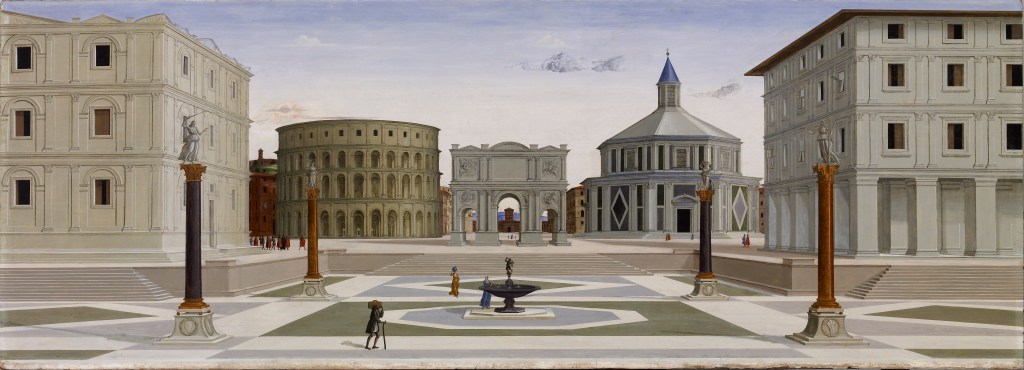
If you enter the Walters Art Gallery by its old entrance, climb the marble staircase, jump over a stanchion, and go past a minor Raphael, you will come across a utopian vision of a city. Because of where it is now hung, the painting is known as The Ideal City of Baltimore.
The landscape, painted by an anonymous hand in the Quattrocento, adheres to an idea that Italian thinkers rediscovered in ancient texts, then freshly translated. Classical authors claim that perfection is arrived at through a study of the human being, the highest creation, they say, to be found in nature. One should examine the human form—shaped by the Highest Architect—with a penetrating eye. And once a study of this ideal model is completed, burnished to the degree that you are able, you may build your city in accordance with it.
An ideal city, therefore, is an ideal human being, transcribed.
***
Note that the city is complete, perfectus, because within its walls are (clockwise from left) administrative offices, domiciles, fields for corn, a coliseum, a place of worship, more offices, and water, all oriented around a piazza, where one may discourse.
***
Because it is perfect, the city is uninhabitable. The handful of human figures — likely added by a later hand, to add life — are diminished less by the magnitude of the city’s buildings than by the plan’s unyielding correctness.
***
This painting cannot take credit for creative urban planning. No inch of its design deviates from rules set out by the Roman architect Vitruvius or his Italian interpreters, Palladio and Alberti. Even on the coliseum, the capital orders follow the more famous one in Rome.
But Renaissance Italians had a technology that the ancients did not —mathematical perspective. Through the divine gift of this sight, one can peer deeply into the consummate soul, delimited in palpable form. Admire, the painter asks, the perfect proportions therein, untouched by time.
***
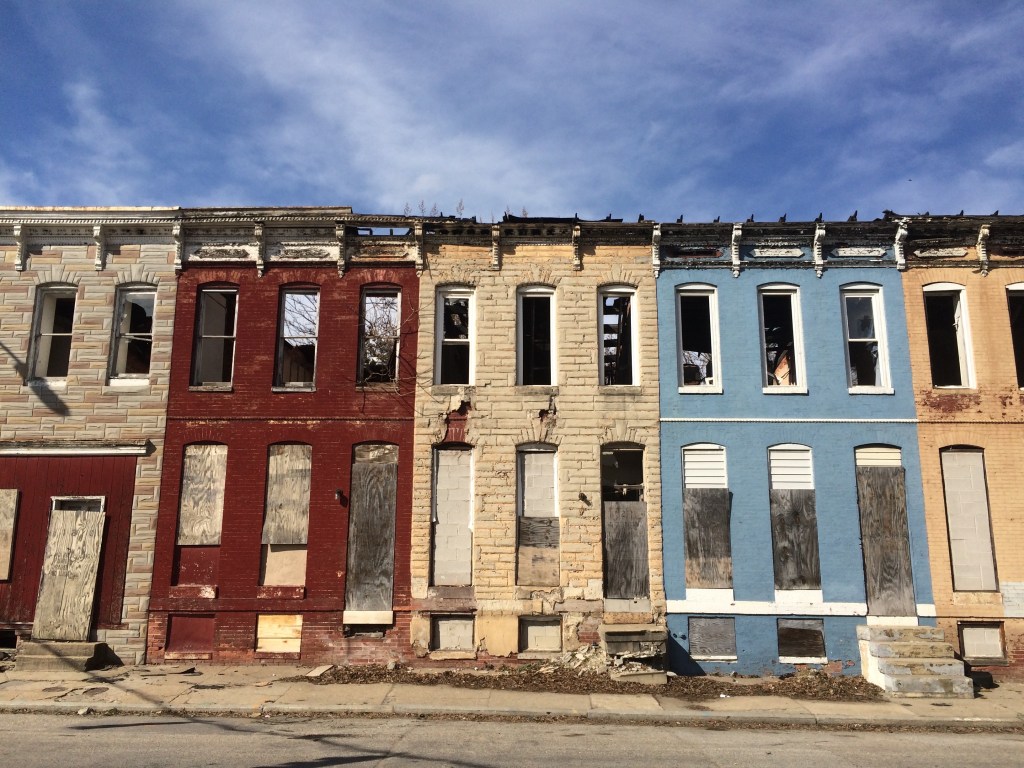
Exiting the museum, you will find another landscape shaped by Greco-Roman norms. The Baltimore rowhouse — the modal building type in the city — hews to the same Palladian rules that regulate the painting. Thousands of such rowhouses sit abandoned: their innards collapsed, wooden frames putrefying in a tangle; outer ratios still ideal.
 Essays